‘Balikatan unrelated to standoff in Panatag Shoal’
By DJ YapPhilippine Daily Inquirer
4:30 pm | Sunday, April 22nd, 2012
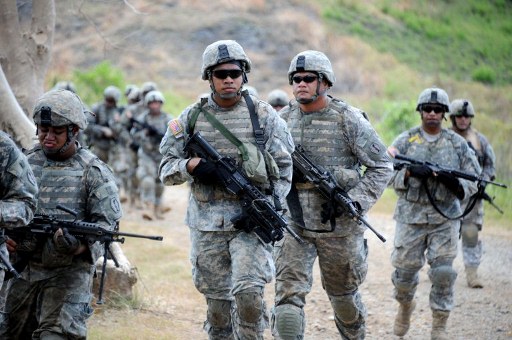
US army soldiers take part in a joint Philippines-US military exercise at the military camp of Fort Magsaysay, Nueva Ecija, on Saturday, April 21, 2012. The Philippine military said Sunday the war exercises, dubbed Balikatan, would continue despite China’s warning on Saturday that the exercise in the disputed West Philippine Sea (or South China Sea) have been raising the risks of an armed confrontation. AFP PHOTO/NOEL CELIS
MANILA, Philippines â€" The Philippine military shrugged off on Sunday China’s warning that the former’s Balikatan (shoulder-to-shoulder) exercises with United States troops in the disputed West Philippine Sea (or South China Sea) have been raising the risks of an armed confrontation.
Major Emmanuel Garcia, the military’s spokesperson for Balikatan, said China had no reason to feel concerned about the annual bilateral exercises with the American military, whose interests in the Asia-Pacific had long stoked Chinese distrust.
“We are not going to stop Balikatan (in spite of China’s warnings). This has long been planned, whether there are issues or not with Panatag Shoal,†he said.
Garcia added: “This is not directed towards or against any nation.â€
On Saturday, China’s military, through its official paper, warned the United States that the Balikatan exercises had raised risks of armed confrontation over the disputed seas, in what news reports described as its “toughest high-level warning yet†following weeks of tension.
Too far from shoal
But Garcia said the location of the war games was too far from the shoal. “Napakalayo po (It is too far). The Balikatan is being conducted in many places, such as Fort Magsaysay (in Nueva Ecija)… Ternate, Cavite… Palawan,†Garcia said.
The Balikatan 2012 involves some 4,500 US troops and 2,300 Filipino troops. The exercises are attracting more attention than usual with some drills to be held close to sensitive waters claimed by the Chinese, particularly those surrounding the disputed Spratly chain of isles and reefs near Palawan.
Garcia said in a radio interview that the two-week Balikatan featuring naval drills was not in any way connected to the continuing standoff between China and the Philippines in the Scarborough Shoal, also called Panatag Shoal by Filipinos.
“We maintain that the Panatag Shoal is not connected in any way to the Balikatan exercises. The Balikatan has long been planned, and its purpose is interoperability between US and Philippine troops and exchange of ideas,†Garcia said on dzBB radio.
Non-combat aspects
He stressed that although both sides would continue the program on “traditional combat maneuvers,†the Balikatan would largely focus on non-combat aspects, such as humanitarian and disaster response.
Scarborough Shoal lies north of the Spratly chain of islands, 120 kilometers off Zambales province on the western coast of Luzon.
A Philippine Coast Guard search-and-rescue vessel, the BRP Edsa, is facing off with two Chinese vessels at the shoal in a 13-day territorial impasse set off on April 10 by Chinese fishing vessels poaching in the area.
The poachers, aboard fishing vessels, slipped out of the area with their illegal catch under the protection of the two Chinese surveillance vessels, angering Philippine officials.
In a related statement, Armed Forces of the Philippines Chief of Staff Jessie Dellosa said the Balikatan 2012 “aims to strengthen and enhance internal Philippine HADR [humanitarian and disaster response] processes through collaborative dialogue.â€
“The different approaches employed by other countries in HADR will surely help us widen our perspective and improve our policies, procedures, preparations, and responses in the emergence of natural calamities and man-made disasters in the Philippines,†he said.
Recent Stories:
Tags: Armed Forces of the Philippines , Balikatan , China , Emmanuel Garcia , geopolitics , Global Nation , Jessie Dellosa , joint military exercises , Philippines , Scarborough Shoal , Spratly Islands , territorial disputes , Territories , United States , Visiting Forces Agreement
Factual errors? Contact the Philippine Daily Inquirer's day desk. Believe this article violates journalistic ethics? Contact the Inquirer's Reader's Advocate. Or write The Readers' Advocate:


No comments:
Post a Comment