Manila: Don’t cross Philippine waters
Philippine Daily Inquirer12:06 am | Tuesday, July 17th, 2012
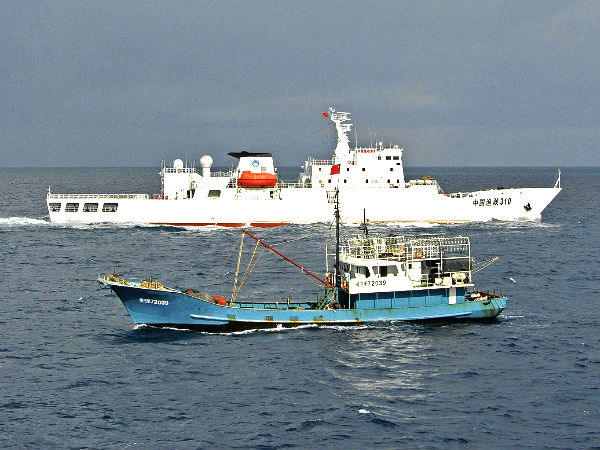
FISHING IN TROUBLED WATERS In this photo released by China’s Xinhua news agency, a Chinese fishery administration ship (background) guards a Chinese fishing vessel near Yongshu Reef in the Spratly Islands, in the West Philippine Sea, on Sunday. A fleet of 30 fishing vessels arrived at the reef where China has an ocean observatory and will spend 10 days of fishing, according to Xinhua. AP / XINHUA
BEIJINGâ€"A big fleet of Chinese fishing vessels arrived at the disputed Spratly Islands in the West Philippine Sea (South China Sea) on Sunday, state media said, amid tensions with China’s neighbors over rival claims to the area.
The Philippines, locked in a territorial row with China over Panatag Shoal (Scarborough Shoal) in the West Philippine Sea, on Monday said the Chinese fishing fleet should not cross into Philippine territory in the Spratlys.
But the Chinese fishing expedition is apparently not a show of force directed at the Philippines but at Vietnam, which claims the Paracel Islands and parts of the Spratlys where the fleet arrived on Sunday.
The fleet of 30 fishing vessels arrived near the Yongshu Reef in the afternoon after setting off on Thursday from the Chinese province of Hainan, the official Xinhua news agency reported.
Yongshu Reef is the Johnson South Reef in the Spratlys that both China and Vietnam claim. Their competing claims erupted into a naval skirmish on March 14, 1988. Vietnam lost the firefight. It lost one vessel and took home another heavily damaged.
Vietnam’s loss left China in effective control of the reef. China later occupied seven other reefs in the area. Today it has a maritime observation station on Johnson South Reef.
The Philippines claims parts of the Spratlys, but not Johnson South Reef.
Don’t intrude
Even so, the Department of Foreign Affairs (DFA) on Monday said that the Chinese fishing vessels “must not intrude into the exclusive economic zone of the Philippines.â€
In a statement issued after news of the fleet’s arrival reached Manila, the DFA asked China to “respect the sovereign rights of the Philippines to the resources†within the country’s 370-kilometer exclusive economic zone.
Chinese fishing boats regularly travel to the Spratlys, a potentially oil-rich archipelago that China claims as part of its territory on historical grounds.
But the fleet is the largest ever launched from Hainan, according to the Xinhua report.
The fleet includes a 3,000-ton supply ship, and a patrol vessel has also traveled to the area to provide protection, the report said. The vessels will spend the next five to 10 days fishing in the area, it added.
The fleet’s arrival came after China earlier Sunday extricated a naval frigate that got stranded four days earlier on Hasa-Hasa Shoal (Half Moon Shoal), part of Philippine territory in the Spratlys.
No protest
The Philippines, however, did not lodge a diplomatic protest over the incident, saying the stranding of the vessel in its exclusive economic zone was likely an accident.
“We don’t believe that there were ill-intentions that accompanied the presence of that ship in our [exclusive economic zone],†Foreign Secretary Albert del Rosario said on Sunday.
“As far as filing a diplomatic protest is concerned, my stance is that we will probably not do that,†Del Rosario said.
But Malacañang said Monday that the Philippines would not call the incident an accident until after its confirmation by a foreign affairs department investigation.
Presidential spokesperson Edwin Lacierda said the government still had to receive “any reason, why, how that frigate happened to be there.â€
The People’s Liberation Army Missile Frigate No. 560 was on a “routine patrol,†China said, when it ran aground on Hasa-Hasa Shoal, 111 kilometers west of Palawan, in the Philippine exclusive economic zone.
The Chinese Embassy in Manila said the frigate was “refloated successfully†before daybreak on Sunday, and Del Rosario said he was informed it was already on its way back to China.
“We wish its crew a safe voyage back to China,†Del Rosario said.
No intention to leave
But Senator Gregorio Honasan, vice chairman of the Senate defense committee, said the incident was likely to happen again, as China apparently had no intention to leave the Spratlys or any other part of the West Philippine Sea where it had territorial claims.
“It would be definitely repeated,†Honasan, speaking in Filipino, told the Philippine Daily Inquirer. “The report saying their ship ran aground means they have not left the area. That is clear.â€
Honasan said it was possible China was bracing for talks on joint exploration with other claimants to territory in the West Philippine Sea.
China is maintaining a constant presence in the area so as not to be left out of the discussions, Honasan said.
China has adamantly refused to bring the territorial disputes in the region to the international level, but has not rejected joint exploration with its rivals, he said.
China’s endgame
“My feeling is that the endgame for China is to partake of the resources in the disputed areas,†Honasan said. “When you are negotiating, you negotiate from a position of strength. You will indicate your maximum position.â€
But Honasan said he did not favor bilateral talks with China. “It’s better to bring this issue to a multilateral forum,†he said.
China says it has sovereign rights to all the West Philippine Sea, believed to sit atop vast oil and gas deposits, including areas close to the coastlines of other countries and hundreds of kilometers from its own landmass.
But Taiwan, Vietnam, Brunei, Malaysia, and the Philippines also claim parts of the South China Sea.
The Spratlys are one of the biggest island chains in the area.
Potential flash point
The rival claims have long made the West Philippine Sea one of Asia’s potential military flash points, and tensions have escalated over the past year.
The Philippines and Vietnam have complained that China is becoming increasingly aggressive in its actions in the areaâ€"such as harassing fishermenâ€"and also through bullying diplomatic tactics.
The Philippines said the latest example of this was at the annual Southeast Asian talks in Cambodia that ended on Friday in failure because of the West Philippine Sea issue.
The Philippines had wanted its fellow members of the Association of Southeast Asian Nations to refer in a joint statement to a standoff last month with China over Panatag Shoal.
But Cambodia, the summit’s host and China’s ally, blocked the move. Reports from AFP, Cathy C. Yamsuan, Jerry E. Esplanada and Christine O. Avendaño
Join us on

Recent Stories:
Tags: Asia-Pacific , China , Diplomacy , Foreign affairs , Global Nation , International relations , Maritime Dispute , Military , Philippines , South China Sea , sovereignty , Spratly Islands , West Philippine Sea
Factual errors? Contact the Philippine Daily Inquirer's day desk. Believe this article violates journalistic ethics? Contact the Inquirer's Reader's Advocate. Or write The Readers' Advocate:


No comments:
Post a Comment